
8-Day Italy Itinerary by Train: Rome, Florence & Venice
A realistic eight-day Italy itinerary connecting Rome, Florence, and Venice by high-speed train, with a day-by-day route and an editable Huvver template.
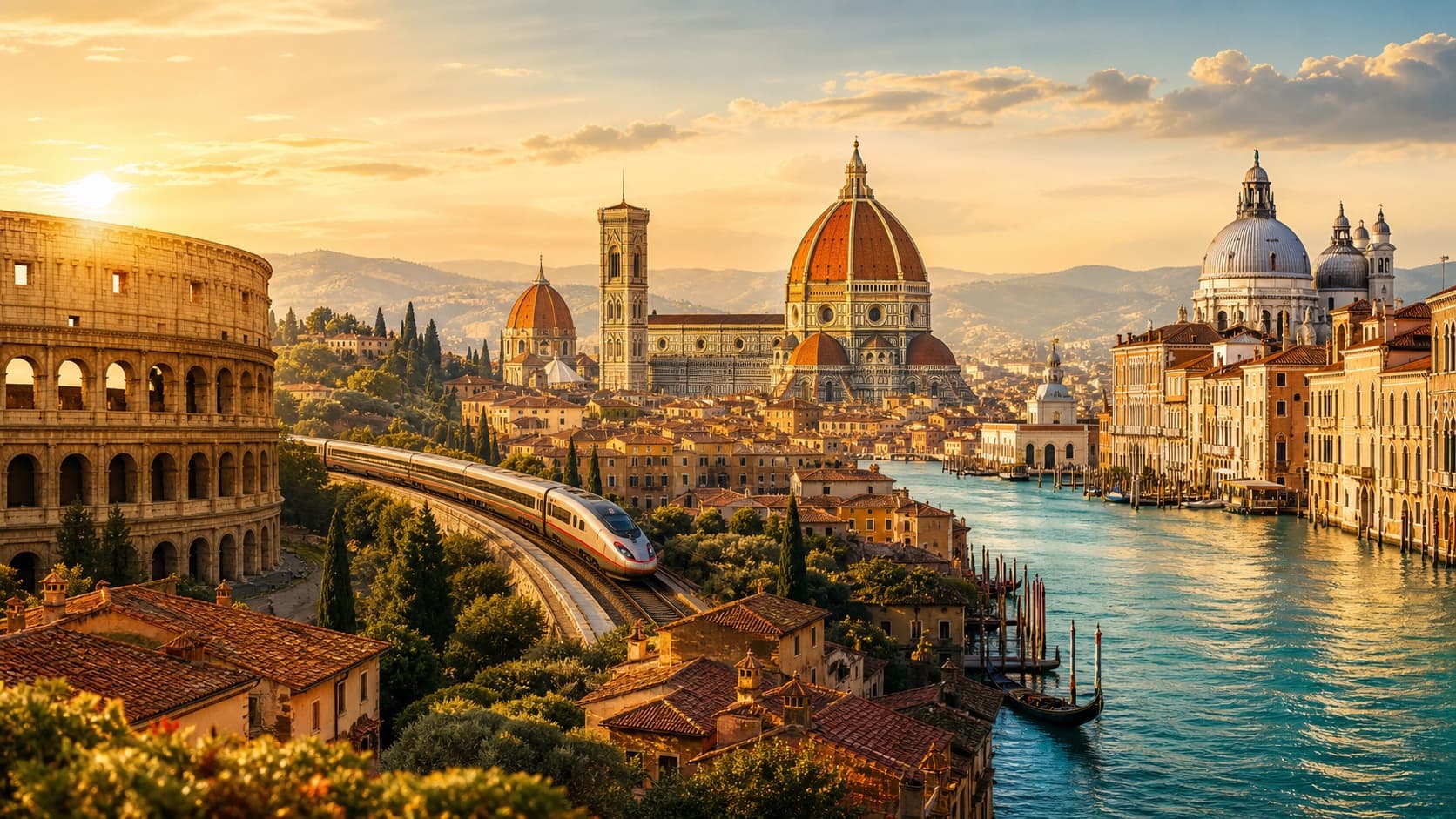
The route
Rome → Florence → Venice
- Route
- Rome → Florence → Venice
- Overnight plan
- 3 nights Rome · 2 nights Florence · 2 nights Venice
- Pace
- Three city bases
- Best for
- First-time visitors
In this guide· 8-day route
Quick answer
The best route for 8 days · 7 nights
Spend three nights in Rome, two in Florence, and two in Venice. Travel north in one direction by high-speed train, arriving in Rome and departing from Venice when flight options allow. That gives you six useful sightseeing days, two lighter transfer days, and no wasted return journey.
Eight days is enough for a first look at Rome, Florence, and Venice when you resist adding a fourth base. The cities are connected by fast, city-center-to-city-center trains, so this route works without a rental car and keeps hotel changes to a manageable two.
The schedule below gives the major sights their own geographic clusters instead of sending you back and forth across each city. Arrival and transfer days stay deliberately lighter, while the full days each have one demanding reservation and room for meals, wandering, and delays.
Why this route works
- The route moves north without backtracking: Rome first, Florence in the middle, and Venice last.
- Rome receives the most time because its headline sights are spread across several districts and reward early reservations.
- Both rail moves happen in the morning, leaving useful afternoons in Florence and Venice.
- The plan uses walkable clusters after arrival, so a delayed train does not ruin a tightly timed booking.
Day by day
The complete 8 days itinerary
Day 1 · Rome
Arrive in Rome and walk the historic center
Check in, then use the afternoon as a gentle orientation rather than a full sightseeing day. Walk from the Trevi Fountain to the Pantheon and finish around Piazza Navona. These stops are close enough to rearrange around your arrival time and energy.
- Hotel check-in
- Trevi Fountain
- Pantheon
- Piazza Navona dinner
Good to know: If you land late, keep only dinner and move the fountains-and-squares walk to an early morning.
Day 2 · Rome
Ancient Rome without crossing the city twice
Start with a reserved Colosseum entry, continue directly through the Roman Forum and Palatine Hill, then take in the view from Capitoline Hill. End in Monti so the evening stays close to the day’s archaeological cluster.
- Colosseum
- Roman Forum
- Palatine Hill
- Capitoline Hill
- Monti
Good to know: The Forum and Palatine are the long outdoor stretch. Carry water and avoid stacking another major museum onto this day.
Day 3 · Rome
Vatican City, the river, and Trastevere
Book the Vatican Museums for the morning, then visit St. Peter’s Basilica before walking toward Castel Sant’Angelo. Cross the river later for a slower evening in Trastevere. Keeping the day west of the historic center reduces transit and leaves flexibility for queues.
- Vatican Museums
- St. Peter’s Basilica
- Castel Sant’Angelo
- Trastevere
Good to know: Treat the dome climb as an optional extra; it can add an hour or more to an already substantial day.
Day 4 · Florence
Train to Florence and a sunset overview
Take a morning high-speed train from Roma Termini to Firenze Santa Maria Novella. After dropping your bags, see the Duomo exterior and cross the Arno for sunset at Piazzale Michelangelo, followed by dinner in Oltrarno.
- Rome Termini
- Florence Santa Maria Novella
- Florence Duomo
- Piazzale Michelangelo
- Oltrarno
Good to know: Direct high-speed trains typically make the Rome–Florence journey in about 90 minutes, but confirm the timetable for your date.
Day 5 · Florence
Renaissance Florence at a humane pace
Reserve the Uffizi for the morning, walk across Ponte Vecchio, and stop for lunch near Mercato Centrale. Choose the Accademia or a Duomo climb as the afternoon anchor; doing both can make the day feel like a museum relay.
- Uffizi Gallery
- Ponte Vecchio
- Mercato Centrale
- Accademia or Duomo climb
Good to know: The Huvver template keeps both afternoon options visible so you can decide after ticket availability and energy are known.
Day 6 · Venice
Train to Venice and stay out after the day-trippers
Travel from Florence to Venezia Santa Lucia in the morning. After check-in, follow the lanes toward Rialto and St. Mark’s Square without trying to optimize every turn. Finish with a cicchetti crawl once the busiest day-trip crowds begin to leave.
- Florence Santa Maria Novella
- Venezia Santa Lucia
- Rialto Bridge
- St. Mark’s Square
- Cicchetti crawl
Good to know: Florence–Venice high-speed services take roughly two hours. Choose Santa Lucia, not Mestre, if you want to arrive on the islands.
Day 7 · Venice
Venice landmarks and the lagoon
See Rialto Market early, then use timed tickets for St. Mark’s Basilica and the Doge’s Palace. Make Burano the optional half-day: it is rewarding, but the boat journey consumes real time. Return for the Grand Canal at blue hour.
- Rialto Market
- St. Mark’s Basilica
- Doge’s Palace
- Optional Burano
- Grand Canal
Good to know: If this is your only full day in Venice, skip Burano when the lagoon is busy or the city itself still feels unfinished.
Day 8 · Venice
Dorsoduro before departure
Use the final morning for an unhurried Dorsoduro walk, a café, and any last views across the Giudecca Canal. Leave a generous airport buffer: Venice departures involve a walk plus a boat, bus, or private transfer rather than a simple curbside ride.
- Dorsoduro morning walk
- Hotel checkout
- Venice Marco Polo Airport
Before you go
Make the plan dependable
Book the three hard tickets first
Secure the Colosseum, Vatican Museums, and your preferred Florence museum before filling in smaller stops. Add St. Mark’s Basilica and the Doge’s Palace once the Venice day is settled.
Compare both high-speed operators
Trenitalia and Italo both serve the core route. Compare departure time, fare rules, and the exact station before buying; advance fares are usually less flexible.
Pack for stairs and uneven ground
Historic centers reward light luggage and comfortable shoes. Venice in particular adds bridges and walks between the station, vaporetto stops, and accommodations.
Protect the transfer afternoons
Do not attach a nonrefundable timed entry to the first hour after a train. The plan uses flexible walks on arrival days for exactly that reason.
Make it yours
Useful variations
For a slower trip
Skip Burano, choose either the Accademia or Duomo climb, and keep the first Rome afternoon completely open. You still see the defining places without turning every day into a checklist.
For art-first travelers
Keep the Uffizi and Accademia, then replace Burano with the Peggy Guggenheim Collection or Gallerie dell’Accademia in Venice.
If flights are cheaper from Rome
Reverse the route—Venice to Florence to Rome—rather than adding a final return train. The same day clusters still work in the opposite direction.
FAQ
Common planning questions
Is eight days enough for Rome, Florence, and Venice?
Yes, for a highlights-focused first trip. Seven nights gives Rome three nights and Florence and Venice two each. It is not enough if you also want relaxed day trips into Tuscany, the Amalfi Coast, or the Dolomites.
Do I need a rental car for this Italy itinerary?
No. High-speed trains connect the three city centers, and the daily sightseeing clusters are primarily walkable. A car adds parking and restricted-traffic complications without improving this particular route.
Should I start in Rome or Venice?
Use the direction that fits the best open-jaw flights. Rome to Florence to Venice is intuitive, but reversing it works equally well. Avoid returning to your first city solely for the flight unless the fare difference justifies the lost time.
Is a rail pass necessary?
Usually not for only two high-speed journeys. Compare point-to-point fares for your exact dates before buying any pass, and check the change and refund terms as carefully as the headline price.
Official planning sources
Planning sources checked on September 21, 2026. Schedules, prices, opening rules, weather, and access can change; confirm the live details before booking or setting out.
- Trenitalia destinations
Official operator information for Rome–Florence and other high-speed connections.
- Italo Florence–Venice
Official route timing and station information.
- Italia.it high-speed rail guide
Italy’s official tourism site on city-center rail travel.
Take the route with you—and change anything
Copy the full itinerary into your account, add your dates, invite your travel companions, and adjust the plan against its map.
More routes
Keep planning
 Iceland
Reykjavík → Golden Circle → Vík → Blue Lagoon → Reykjavík
5 days in Iceland
A realistic five-day Iceland road trip through Reykjavík, the Golden Circle, Vík, and the South Coast, with driving logic and an editable Huvver template.
Read the itinerary Japan
Tokyo → Hakone → Kyoto → Nara → Osaka
10 days in Japan
A realistic ten-day Japan itinerary through Tokyo, Hakone, Kyoto, Nara, and Osaka, with train logic and an editable Huvver template.
Read the itinerary Portugal
Lisbon → Sintra → Coimbra → Porto
7 days in Portugal
A realistic seven-day Portugal itinerary connecting Lisbon, Sintra, Coimbra, and Porto, with a day-by-day route and an editable Huvver template.
Read the itinerary