
10-Day New Zealand South Island Road Trip: Aoraki to Milford
A weather-aware ten-day New Zealand South Island road trip through Lake Tekapo, Aoraki/Mount Cook, Wānaka, Queenstown, and Milford Sound, with an editable Huvver template.
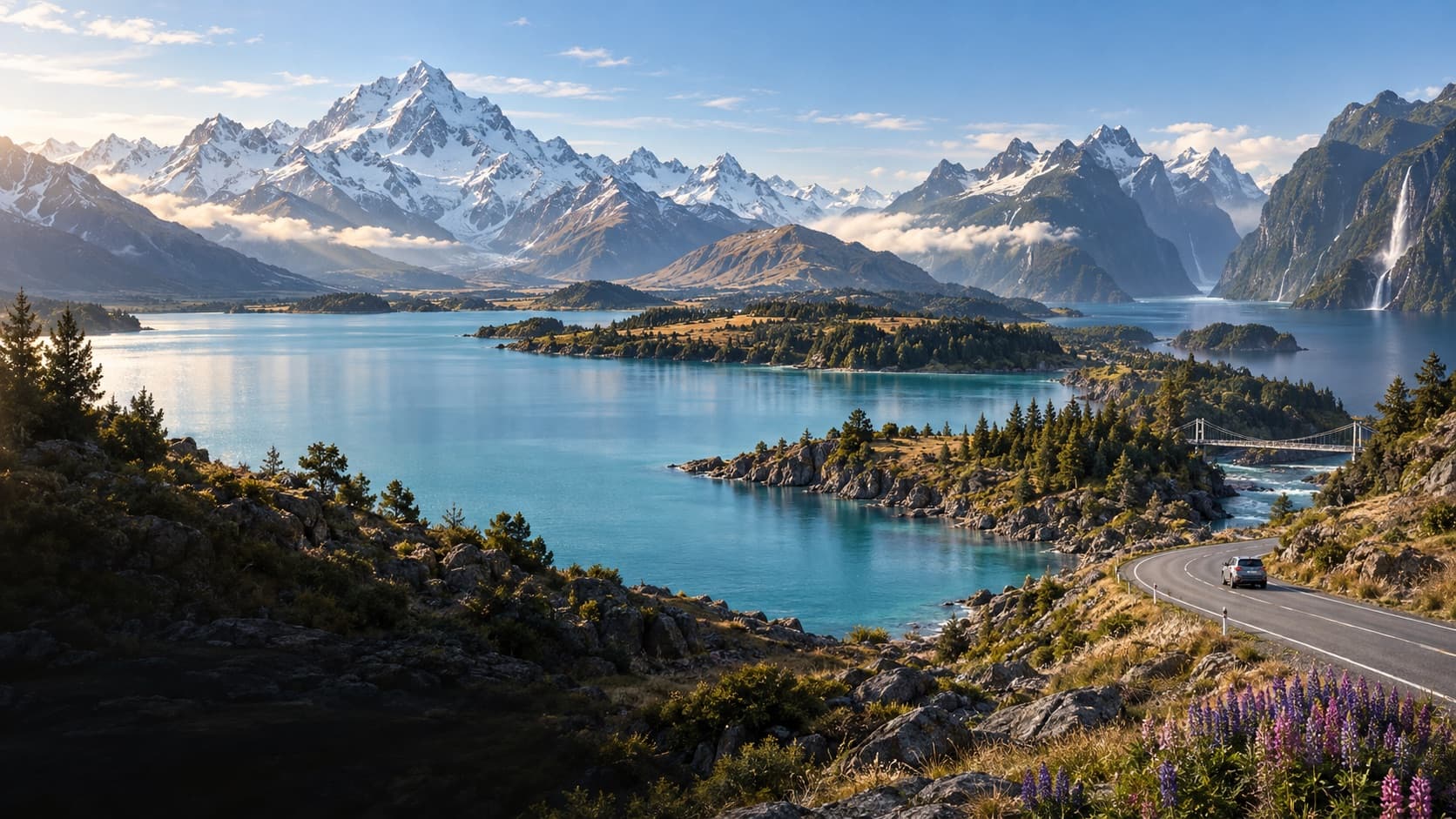
The route
Christchurch → Tekapo → Aoraki → Wānaka → Queenstown → Milford Sound
- Route
- Christchurch → Tekapo → Aoraki → Wānaka → Queenstown → Milford Sound
- Overnight plan
- 1 Christchurch · 1 Tekapo · 2 Aoraki · 2 Wānaka · 1 Queenstown · 1 Te Anau · 1 Queenstown
- Pace
- Five alpine bases with two two-night stays
- Best for
- First-time visitors
In this guide· 10-day route
Quick answer
The best route for 10 days · 9 nights
Drive from Christchurch to Lake Tekapo, spend two nights at Aoraki/Mount Cook and two in Wānaka, then continue through Queenstown to Te Anau for Milford Sound. Return to Queenstown for the final night. The two-night mountain stays provide essential weather flexibility; a coach from Te Anau can replace the longest driving day.
Ten days is enough for the South Island’s central alpine corridor when the route does not also attempt the West Coast, Kaikōura, and the far south. Distances look modest, but viewpoint stops, one-lane bridges, weather, and road closures make driving days longer than a map suggests.
The itinerary gives Aoraki/Mount Cook and Wānaka two nights each, stages Milford from Te Anau, and returns to Queenstown before departure. It treats every major walk as conditional on current Department of Conservation alerts rather than promising access months ahead.
Why this route works
- The route moves one way from Christchurch to Queenstown without returning to the east coast.
- Two Aoraki nights give the Hooker Valley plan a weather backup.
- Wānaka receives a full day so it is more than a lunch stop between mountain roads.
- Te Anau shortens and de-risks the Milford morning compared with a same-day Queenstown departure.
Day by day
The complete 10 days itinerary
Day 1 · Christchurch
Arrive in Christchurch and recover before driving
Collect the car only if rested enough to drive on the left, check in for one night, and use the Botanic Gardens or Avon River as the arrival walk. Do not begin the Tekapo drive after a long-haul evening arrival.
- Christchurch Airport
- Hotel check-in
- Botanic Gardens
- Early dinner
Day 2 · Lake Tekapo
Drive to Lake Tekapo with a Geraldine break
Leave Christchurch after breakfast, stop in Geraldine, and continue to Lake Tekapo for one night. Walk to the Church of the Good Shepherd and make stargazing optional rather than essential.
- Christchurch
- Geraldine
- Lake Tekapo
- Dark-sky evening
Good to know: Reserve Tekapo lodging early; limited inventory can dictate the entire route’s dates.
Day 3 · Aoraki/Mount Cook
Lake Pukaki and Aoraki/Mount Cook
Pause only at signed Lake Pukaki viewpoints, refuel, then drive the alpine road into Aoraki/Mount Cook for two nights. Use Kea Point or another short track only when weather and daylight are settled.
- Lake Pukaki
- Aoraki/Mount Cook Village
- Kea Point Track
Day 4 · Aoraki/Mount Cook
Hooker Valley with a weather fallback
Check current DOC alerts and the forecast before setting out on the Hooker Valley Track. If wind, flooding, bridge work, or visibility is poor, use the alpine center and shorter open tracks instead.
- DOC conditions check
- Hooker Valley Track
- Alpine Centre fallback
Good to know: A saved itinerary is not a safety clearance. Recheck conditions on the morning and turn around when they change.
Day 5 · Wānaka
Cross Lindis Pass to Wānaka
Leave the national park, stop at the signed Lindis Pass viewpoint if conditions allow, and check in for two nights in Wānaka. Keep the arrival afternoon to the lakefront.
- Aoraki departure
- Lindis Pass
- Wānaka check-in
- Lakefront walk
Day 6 · Wānaka
Choose a Wānaka walk that suits the conditions
Use Diamond Lake for a scalable morning walk, selecting the lower or upper route based on conditions and fitness. Leave the afternoon open for weather recovery, swimming, a winery, or a café.
- Diamond Lake Track
- Wānaka lunch
- Flexible lake afternoon
Good to know: The most photographed high routes are not default activities; exposure, heat, and fitness should decide the day.
Day 7 · Queenstown
Crown Range or Cromwell to Queenstown
Check road conditions, then choose the Crown Range or the lower route through Cromwell. Stop in Arrowtown before checking in for one Queenstown night and walking the lakefront.
- Road-conditions check
- Crown Range or Cromwell
- Arrowtown
- Queenstown
Day 8 · Te Anau
Slow the route down in Te Anau
Drive south with a break around Kingston, check in for one night in Te Anau, fuel the car, and walk the lake. Keep the afternoon quiet before the early Milford start.
- Queenstown departure
- Kingston
- Te Anau check-in
- Lake Te Anau
Day 9 · Queenstown
Milford Sound and the return to Queenstown
Check the Milford Road status before departure, allow generous scenic-road time, and take a reserved cruise. Return to Queenstown for the final night, or use a coach day to reduce fatigue and let everyone see the road.
- Milford Road
- Milford Sound cruise
- Te Anau break
- Queenstown
Good to know: This is the longest day. A coach from Te Anau is often the better choice when there is only one confident driver.
Day 10 · Departure day
Depart from Queenstown
Fuel and return the car, then depart from Queenstown Airport. Keep the morning unbooked unless the flight is late and road conditions are completely ordinary.
- Queenstown checkout
- Fuel stop
- Rental-car return
- Queenstown Airport
Before you go
Make the plan dependable
Read road and track alerts every morning
Use NZTA for highways and DOC for tracks. Snow, slips, flooding, wind, fire risk, and bridge work can all change a plan that looked safe when it was saved.
Reserve the scarce nights first
Aoraki/Mount Cook, Tekapo, Te Anau, and peak-season car availability can dictate the route. Secure those before filling in activities.
Do not underestimate driver fatigue
Left-side driving, mountain roads, viewpoints, and unfamiliar conditions demand attention. Rotate drivers when possible and use a Milford coach when the long return is questionable.
Keep fuel and food ahead of the car
Refuel before remote roads and carry water, layers, and food. Mobile coverage is not continuous, so download the board and official road information.
Make it yours
Useful variations
For a slower trip
Skip Milford Sound and split the Te Anau night between Queenstown and Wānaka. The alpine core remains excellent with shorter drives.
For a West Coast extension
Add at least three nights for Haast, glacier country, and the long onward route. Do not bolt it onto the existing ten days.
For a one-way rental surcharge
Compare the total trip cost, not only the daily rate. A Christchurch return usually sacrifices more time than it saves in rental fees.
FAQ
Common planning questions
Is ten days enough for New Zealand’s South Island?
Yes for the central alpine route from Christchurch to Queenstown. It is not enough for this itinerary plus the West Coast, Abel Tasman, Kaikōura, and the Catlins.
Do I need a rental car for this itinerary?
A car gives the most practical access to Tekapo, Aoraki, and Wānaka. Some coach itineraries can cover the corridor, but they require a different schedule. Consider a coach specifically for the Milford day.
Should I stay in Te Anau before Milford Sound?
Yes on this route. It shortens the morning, creates time to check the road, and reduces the length of an already demanding day compared with starting in Queenstown.
What if the Hooker Valley Track is closed?
Follow DOC instructions and use an open short track, the alpine center, or a quiet village day. Never bypass a closure; the second Aoraki night protects the trip from a single poor-weather window.
Official planning sources
Planning sources checked on September 21, 2026. Schedules, prices, opening rules, weather, and access can change; confirm the live details before booking or setting out.
- Tourism New Zealand: South Island mountains and glaciers
Official route context for Christchurch, alpine lakes, Queenstown, Milford, and Aoraki.
- DOC: Hooker Valley Track
Official track status, hazards, access, and visitor guidance.
- NZTA highway conditions
Official live highway conditions and closures for driving days.
- Milford Road project information
Official SH94 conditions, avalanche controls, and road context.
Take the route with you—and change anything
Copy the full itinerary into your account, add your dates, invite your travel companions, and adjust the plan against its map.
More routes
Keep planning
 Switzerland
Zürich Airport → Lucerne → Interlaken → Zermatt → Zürich Airport
8 days in Switzerland by train
A realistic eight-day Switzerland itinerary through Lucerne, the Bernese Oberland, and Zermatt, with mountain-weather alternatives and an editable Huvver template.
Read the itinerary South Korea
Seoul → Gyeongju → Busan
9 days in South Korea
A rail-first nine-day South Korea itinerary through Seoul, Gyeongju, and Busan, with palace, market, heritage, and coastal days plus an editable Huvver template.
Read the itinerary Croatia
Split → Hvar → Dubrovnik
9 days on Croatia’s coast
A practical nine-day Croatia itinerary from Split through Hvar to Dubrovnik, with seasonal ferry planning, car-free old towns, and an editable Huvver template.
Read the itinerary