
Planning methods
How to Plan a Flexible Itinerary That Still Gets You There
You want a plan because you would rather enjoy the trip than research dinner on a pavement. You also want to stay when a neighborhood turns out to be wonderful. A flexible itinerary can give you both, provided you decide which parts really need to hold their place.
By the Huvver team · Reviewed October 23, 2026

The short answer
Keep the confirmed reservations, overnight bases, and essential transport fixed in the plan. Group nearby optional activities around them, leave open time between demanding blocks, and identify a simpler version of each day. Check opening days and current conditions before moving anything with a real deadline.
Give fixed commitments a clear place
Begin with flights, lodging, timed visits, and any transport you have committed to. Record the actual time, place, and relevant booking terms. Everything else can be arranged around those anchors. A useful plan makes it obvious which stop is a possibility and which one expects you at a particular door.
Check opening days before choosing the anchor. The Louvre, for example, lists Tuesday closure and recommends time-slot bookings. You could have plenty of free hours and still miss it if those hours fall on the wrong day. The general lesson is to use the venue calendar while the itinerary is still easy to move.[1]
Use morning and afternoon blocks
Try one main activity per half day as a starting point for a city trip. A long museum visit may fill more than one block; a familiar neighborhood may need very little structure. Adjust around the people, distance, and type of experience. The aim is to see what fits comfortably before you start buying tickets.
Leave meals and some walking time visible. If the only open space is a gap you expect to spend crossing the city, the day has very little actual flexibility. A proper open block gives you somewhere to put a delayed start, a longer lunch, or an unexpected place you want to explore.
Put alternatives near the day you might use them
An alternative helps most when it solves a specific problem. Keep a nearby indoor option for a weather-sensitive afternoon, a short outing for a tired group, and an easy dinner area near the overnight base. A citywide list of twenty possibilities still leaves you researching when the original plan changes.
Check the practical difference between alternatives. A museum that needs advance booking cannot always replace a walk at the last minute. A quieter version of the same neighborhood often gives you more freedom than an entirely different excursion with its own travel and ticket requirements.
| Block | Main plan | Simpler alternative |
|---|---|---|
| Morning | One confirmed visit, with time to reach its entrance. | Keep the booking; drop an optional stop beforehand. |
| Lunch | An area with several suitable options. | Choose a nearby meal if the visit runs long. |
| Afternoon | A walk through the next neighborhood. | A short local stop or a return to the base. |
| Evening | A shared dinner or a free evening. | Meet at a clear place and time after separate afternoons. |
Keep weather decisions close to the day
Use seasonal information to choose the broad trip and near-term forecasts to refine the day. The Met Office explains that small differences in current conditions can affect the weather over the following days. Keep checking the local forecast and warnings rather than treating an early weather-app icon as a fixed fact.[2]
For a park or outdoor activity, make the alternative appropriate to the current conditions and the group. The National Park Service includes checking conditions and having a backup activity in its planning guidance. Changing the plan can mean choosing a different kind of day rather than finding another route to the same exposed destination.[3]
Give the group permission to choose differently
Travelers can share an overnight base and the main experience while spending some time apart. Agree on a meeting place and what happens if someone changes their mind. That makes a flexible afternoon feel like a choice instead of someone falling behind the itinerary.
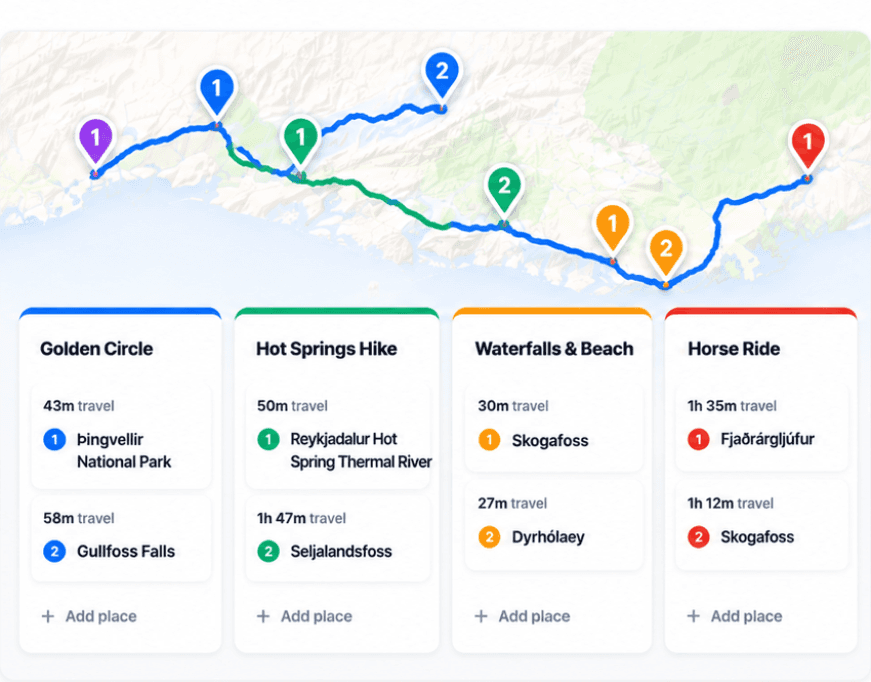
Keep the shared plan current when the group decides. In Huvver, you can leave undecided stops in Ideas and move them onto the day when they fit. The board and map help you see whether an appealing addition also makes sense geographically. Public guides preview complete plans; editable trip ownership requires an annual subscription.[4][5]
Finish with the shorter-day test
Imagine starting an hour later than expected. Which optional stop goes first? Can you still reach the important reservation comfortably? If the answer requires rearranging every part of the day, give the plan more room. That is especially useful on arrival and transfer days, when several pieces are outside your control.
Keep the version of the trip you would enjoy even if a few optional visits disappear. The itinerary should help you notice good choices while you travel. If the place, food, or company is better than expected, having room to stay is part of the plan working.
- Mark the confirmed bookings, essential travel, and overnight bases.
- Group nearby possibilities into morning and afternoon blocks.
- Save an easy alternative and identify the first optional stop to drop.
- Check opening days, current conditions, and the next day’s travel before changing a commitment.
Explore a real trip
See day-by-day routes with maps, notes, and editable Huvver templates.
Sources and review notes
Outside product details are linked to first-party pages. Advice and recommendations are Huvver’s editorial judgment; this article does not imply hands-on testing unless it says so.