
Planning methods
How Many Days Should You Spend in Each City?
You have eight days and a list of cities that would fill three weeks. Dividing the calendar equally feels fair, but cities do not receive equal slices of usable time. One gets your late arrival. Another gets a full morning. The final one may lose its last day to the airport.
By the Huvver team · Reviewed October 23, 2026

The short answer
Allocate nights first, then count the usable mornings and afternoons at each base. Put your fixed activities into those blocks, add complete transfer time, and leave room for meals and slower moments. Give extra nights to the places you want to experience deeply, rather than adding cities simply because a train connects them.
Count nights and usable days separately
Three nights can mean two full sightseeing days, or more if arrival and departure are convenient. It can also mean less if the first evening is late and the final morning starts with a long transfer. Write the actual arrival and departure windows below each city before deciding that it has “three days.”
A helpful first pass uses morning, afternoon, and evening blocks. Label each one available, in transit, or uncertain. Treat the blocks as a first draft and adjust them to your pace. They give the calendar some honest limits before attraction lists expand to fill it.
A seven-night example
Suppose you arrive in City A late on day one and depart City C on the morning of day eight. A three-night, two-night, two-night split gives you two full days in A, a transfer afternoon and one full day in B, and the same pattern in C. That is already a fairly busy trip. These are illustrative assumptions; use your actual connections to decide what the transfer afternoons can hold.
If one city is mainly a place to sleep before departure, say so. You can still enjoy that evening. The problem comes when the itinerary promises a full destination experience in a block that mostly belongs to travel.
| Base | Nights | Time you can reasonably plan around |
|---|---|---|
| City A | 3 | Late arrival, then two full days. |
| City B | 2 | Transfer day with a possible afternoon, then one full day. |
| City C | 2 | Transfer day with a possible afternoon, one full day, then morning departure. |
Let your priorities earn the extra night
List the two or three experiences that made you choose each place. Add a rough visit block and the neighborhood or region. If you want a major museum, a food-focused afternoon, and a day trip, the base needs enough separate blocks to support those choices. If the list is one short walk, consider whether a stop along the route would meet the same goal.
Use venue calendars before moving nights around. The Louvre’s Tuesday closure is a concrete example of why two consecutive days are not always interchangeable. A short stay that crosses the wrong closure day can lose the very visit that justified it. Check the official page for the actual date and current admission arrangements.[1]
Charge each hotel change its full time
Packing, checkout, reaching the station, the journey, finding the next lodging, and settling in all come out of the day. If you enjoy moving around, that can be part of the pleasure. If you dislike luggage and check-in, fewer bases may make the whole trip better even when the distances are manageable.
Check connections close to departure as well as when you first plan. SBB explains that engineering works and disruptions can change timetable information and recommends rechecking the connection. An attractive transfer on an early draft should remain an assumption until you have checked the service for your trip.[2]
Treat a day trip as a day you have already spent
A day trip uses time from the city where you sleep. Label the calendar accordingly: “three nights in A, with one full day in A and one day away” tells you more than “three nights in A.” Include reaching the departure point, onward local travel, and the return, especially if you have an evening reservation.
Compare a day trip with moving base only after you know the full travel. Staying put saves a hotel change. Moving can save repeated journeys. Neither choice wins automatically; the useful question is which arrangement gives you a more enjoyable day with your actual bags, companions, and bookings.
Use a complete route as a starting point
Huvver’s eight-day Italy guide uses three nights in Rome, two in Florence, and two in Venice. It is one published route, not a claim that every traveler needs those exact durations. You can inspect the days and compare the priorities with your own before choosing a different split.[3]
Finish by removing one city on paper. Give its nights to the remaining bases and look at what becomes possible: an unhurried meal, an extra neighborhood, or a less anxious departure. Keep the longer list if you prefer it after that comparison. At least the choice will reflect the holiday you want, rather than the number of pins you saved.
Explore a real trip
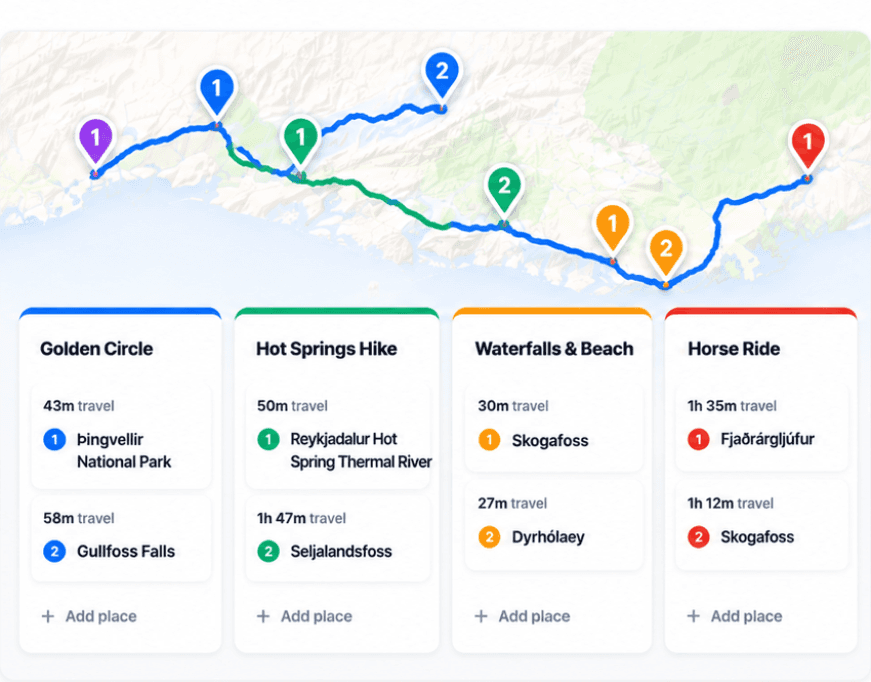
See day-by-day routes with maps, notes, and editable Huvver templates.
Sources and review notes
Outside product details are linked to first-party pages. Advice and recommendations are Huvver’s editorial judgment; this article does not imply hands-on testing unless it says so.