
Planning methods
How to Plan a Multi-City Trip Without Backtracking
A route can look tidy as a list of cities and still waste a day. The problem is usually an unexamined transfer, a day trip that belongs from another base, or a final night chosen for price without considering the departure airport.
By the Huvver team · Reviewed October 20, 2026
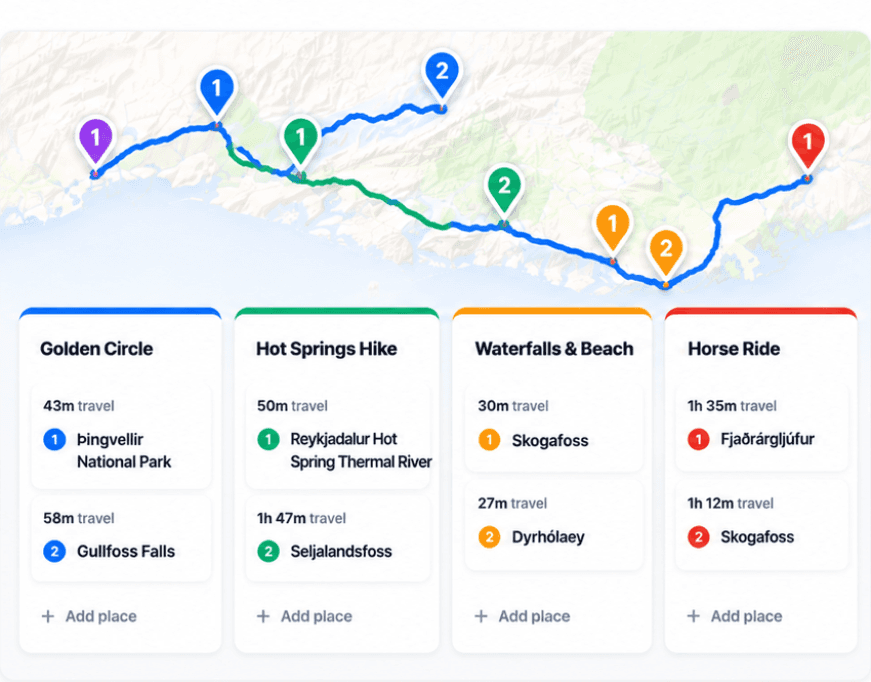
The short answer
Choose your entry and exit points, place overnight bases before attractions, group nearby stops into day clusters, then trace every transfer on a map. Count the time from checkout to check-in rather than only the time spent on a train or road.
Start with the nights, not the attractions
Write the cities or regions you want, the number of nights in each, and the fixed arrival and departure points. Mark any reservations or events that cannot move. A night is a useful planning unit because it tells you where luggage begins the next morning. A list of attractions cannot answer that.
If the route runs A → B → C but your flight leaves from A, the return leg is part of the trip even when it is absent from the attractive middle of the itinerary. Price an open-jaw flight against that final return. Sometimes the round trip ticket is cheaper; sometimes the added travel day erases the saving. Check actual schedules and fares for your dates before deciding.
Draw the backbone and cluster the days
Put each overnight base on a map and connect them in travel order. Look for a line that doubles back or crosses itself. Then assign day trips to the base with the shortest practical round trip, not necessarily the base where you first discovered them. A stop between two bases may belong on the transfer day if its opening hours and luggage logistics allow it.
Keep an Ideas list for places that do not yet fit. Do not force every saved pin into a day. If a detour creates a second hotel change or turns a calm transfer into three unrelated visits, it may be better left for another trip.
For example, consider a traveler arriving in Rome and flying home from Venice who wants to stay in Rome, Florence, and Venice. Rome → Venice → Florence → Venice repeats part of the route. Rome → Florence → Venice removes that return in the city sequence. This is a route illustration, not a promise of the fastest or cheapest tickets: compare actual trains and fixed reservations before changing the order.
Budget the whole transfer
A two-hour train is not a two-hour transfer. Add checkout, getting to the station, a reasonable departure buffer, the journey, reaching the next lodging, check-in or bag storage, and recovery time. Driving has its own costs: pickup, parking, fuel or charging, and breaks. Ferries and mountain roads add weather or seasonal uncertainty.
An illustrative transfer budget might be 20 minutes to check out, 25 to reach the station, a 20-minute boarding buffer, a two-hour train, 30 minutes to the next hotel, and 15 to leave bags. That is 3 hours 50 minutes before lunch or sightseeing. These are made-up allowances for the calculation; replace each with the actual journey and your group’s needs.
Use an official carrier or transport authority for schedules and service notices, then a map for the door-to-door leg. A planning app can keep these legs beside the activities, but no map should be treated as a guarantee that a train runs on your exact date or a road stays open.
Run the backtracking test
Ask four questions for each day: Where do we wake up? Where do we sleep? How many times do we pass the same junction or station? Is the day still pleasant if one reservation slips by an hour? Move the least fixed stop first. Then view all days together to check that a local improvement has not created a worse week.
For a concrete starting point, Huvver’s editable Italy rail guide shows one possible sequence of Rome, Florence, and Venice. Treat it as a route to adapt, not proof that those cities are the best choice for your dates. The value of any template is that the bases, days, and travel legs can be inspected before you commit.[1]
- Write the overnight base for every night in one column and the next morning’s first stop in another.
- Trace the bases in order on a map and mark every repeated stretch, airport return, or awkward cross-country jump.
- Move optional stops before changing fixed bookings; compare the whole route again after each move.
- Check the exact-date service, opening time, and door-to-door transfer before paying for the next reservation.
Explore a real trip
See day-by-day routes with maps, notes, and editable Huvver templates.
Sources and review notes
Outside product details are linked to first-party pages. Advice and recommendations are Huvver’s editorial judgment; this article does not imply hands-on testing unless it says so.